One scoreboard was a rout. The other stayed close enough that every second and third place mattered. BYU won both.
The Cougar men beat UC Santa Barbara 170-54, and the women finished a 122-102 victory Friday night at Samuelson Aquatics Center in Thousand Oaks, California. BYU won 18 of the meet’s 24 events: 11 on the men’s side and seven on the women’s side.
That split tells the useful story. The men left almost no route back into their meet after taking the opening relay. The women lost both relays and five events overall, but Summer Thresher’s backstroke double and a run of individual wins kept UC Santa Barbara from turning its relay advantage into the team result.
BYU-UC Santa Barbara swimming score and event receipt
| Meet | BYU | UC Santa Barbara | BYU event wins | UCSB event wins |
|---|---|---|---|---|
| Men | 170 | 54 | 11 | 1 |
| Women | 122 | 102 | 7 | 5 |
| Combined event wins | n/a | n/a | 18 | 6 |
The final was a 24-event short-course-yard dual, with 12 men’s and 12 women’s races. The official results use the familiar dual-meet point structure: individual places score beyond the winner, while relays carry their own heavier first-place value. That is why an event-win count does not explain either final by itself.
For the men, it almost does. UC Santa Barbara’s only win came from Lucas Hubbard in the 200 backstroke. BYU won everything else, including both relays.
The women’s meet had a different shape. UC Santa Barbara won the opening 200 medley relay and the closing 200 freestyle relay, plus three individual races. BYU had to build its 20-point margin between those two relay losses.
The men’s meet became a depth exercise
Max Kleinman gave BYU the broadest winning line of the night. He took the 100 backstroke in 47.80, won the 200 individual medley and swam on both victorious relays. Four entries, four wins.
That line needs one correction from BYU’s official recap. The school story credits Kleinman with the 200 backstroke, but UC Santa Barbara’s official recap and the complete result show Hubbard winning that race in 1:48.15. Kleinman’s individual wins were the 100 backstroke and 200 IM. The relay results bring his total to four first-place finishes.
The correction does not weaken the larger point. Kleinman affected every phase available to him: backstroke speed, all-four-strokes versatility and two relay groups. He was not piling up four versions of the same race.
Peter Etzold supplied the men’s other double. He won the 100 breaststroke in 52.74 and completed the breaststroke sweep over 200 yards. The 100 result carried an extra depth receipt behind him: Evan VanderSluis finished second in 54.20, and Max Cannon was third in 54.28. One event gave BYU the winner and both supporting scoring places.
That is how a score gets away from an opponent even before the next race begins. A first-place finish creates the headline. A 1-2-3 turns it into separation.
The freestyle wins were spread across three Cougars. Tanner Nelson won the 200. Tanner Edwards took the 50. Joshua Reed won the 100 in 44.84 after helping the 200 freestyle relay close the meet in first.
BYU also covered both butterfly distances through different swimmers. Mattia Reina won the 200 fly, and Jacob Aina took the 100. That distribution matters more than one athlete collecting every available first. It shows that the men’s result was not propped up by a single stroke group.
Hubbard did stop the sweep in the 200 back. Andrew Eliason finished second for BYU in 1:49.44, Dylan Matthews was third in 1:49.64 and Easton Mousser added fifth. Even in UCSB’s one men’s victory, the Cougars placed three scorers directly behind the winner.
The result was severe without being mysterious. BYU won the events at both ends of the program, filled supporting places and denied UCSB the small clusters of points that keep a dual meet within reach.
Thresher gave the women the meet’s cleanest double
The women’s score needed more repair. UC Santa Barbara opened with an 11-point relay win in the 200 medley, then put swimmers first in the 100 breaststroke, 200 butterfly and 50 freestyle before winning the closing 200 free relay too.
Thresher answered in the one stroke where BYU already had an October standard.
The freshman won the 100 backstroke in 53.54, beating Coco Quill by 2.58 seconds. She returned to win the 200 backstroke and finished the meet as the women’s high-point swimmer with two wins, one second place and 18 individual points.
Two weeks earlier, Thresher had broken BYU’s 100 backstroke record with a 52.97 at the Intermountain Shootout. Friday’s time was 0.57 seconds slower, so this was not another record and should not be sold as one. It was still fast enough to create clear water in a dual meet and came with a second backstroke win later in the program.
That distinction is worth keeping. Records are rare. Repeatable wins are how a fast October swim becomes useful to a team.
Thresher’s first collegiate weekend proved she could touch a school record once. The UCSB double showed she could return two weeks later, race both backstroke distances and supply 18 individual points when BYU had already lost the first relay.
The 100 free was BYU’s smallest useful gap
Ana Loveridge won the women’s 100 freestyle in 50.73. Tatum Cooley touched in 50.82.
Nine hundredths separated first from second. Together, those two finishes produced 13 team points before the rest of the field was counted.
That was the kind of race BYU needed in the middle of a 20-point meet. The Cougars did not have to win every event after UCSB’s relay starts. They had to keep one Gaucho winner from becoming a full scoring sweep and turn their own wins into more than nine points whenever possible.
Cooley did not win an individual event, but SwimCloud’s complete results credit her with four second-place finishes and 13 individual points. That tied the individual scoring total of Emilie Griffin, who won the 200 breaststroke and added a second.
The contrast is the whole meet in miniature. Griffin delivered a first. Cooley kept arriving immediately behind winners. Both scored 13.
Haylee Tiffany added the 200 freestyle in 1:50.10. Sarah Eliason won the 100 butterfly. Chesney Bonner closed BYU’s individual-win list with a 2:06.13 in the 200 IM.
Those victories covered freestyle, butterfly, breaststroke, backstroke and medley. The women did not own the relays, and they did not sweep any one corner of the program badly enough to make the math automatic. They won through enough different swimmers to prevent UCSB from finding a soft stretch.
UC Santa Barbara made the women’s final honest
The 122-102 score should not be folded into the men’s 170-54 result and described as one long BYU cruise.
UC Santa Barbara won both women’s relays. Its 200 medley team of CoCo Quill, Miranda Stevenson, Caitlin Brown and Alexi Zuckerman finished in 1:40.54. Zuckerman, Gretta Callison, Stevenson and Eugenie Lanilis won the 200 free relay in 1:31.17.
Lanilis also won the 50 freestyle in 23.08. Stevenson took the 100 breaststroke in 1:02.61, and Maeve Collins won the 200 butterfly in 2:02.25.
That is a credible five-win path: start with a relay, claim a sprint, breaststroke and butterfly race, then take the closing relay. The Gauchos had enough front-line results to pressure BYU’s scoring places all night.
The Cougars’ answer was not one dramatic final touch. It was refusing to leave empty columns behind the seven winners. Thresher added a second place beyond her two wins. Cooley stacked seconds. Griffin paired a win with a second. Loveridge and Cooley went 1-2 in the 100 free.
A 20-point win can sound comfortable when stripped of event order. In dual-meet terms, it stayed live because relay points bookended the program. BYU earned its room in the individual events and had to keep earning it after every UCSB first.
Friday proved two different things
The men’s team showed range and control. Eleven wins across 12 events left no stroke group responsible for hiding another one’s weakness. Kleinman and Etzold supplied doubles, but Nelson, Edwards, Reed, Reina and Aina all owned separate races. The relays held both ends together.
The women’s team showed it could win without the relays. That is not the preferred formula, especially against deeper conference fields, but it is a useful one to have. A team that loses 22 first-place relay points has to be sharp in the individual scoring table. BYU was.
The result also gives context to the Intermountain Shootout recap. In Grand Junction, record swims sat beside a Friday depth problem before both Cougar teams flipped the daily score Saturday. At UCSB, the men carried that depth through nearly the whole card. The women had to solve a different version of it against an opponent that kept winning the relay exchanges.
Neither October meet predicts a February championship. This one does give BYU a cleaner map of where its points are coming from. The men can spread firsts across almost every stroke. The women have a record-level backstroker, multiple individual winners and enough second-place scoring to survive a relay deficit.
What comes next
BYU has almost no recovery window. The Cougars race the MPSF Open Water Championships Saturday at Marine Stadium in Long Beach.
The men’s 5K begins at 10 a.m. Mountain, the women’s 5K at 11:30 a.m., and the two 2,000-meter relays follow in the afternoon. The complete MPSF watch guide has the GOLS stream, championship-results path, scoring rules and four-race schedule.
Friday’s pool score will not carry into open water. Lane speed, turns and walls give way to packs, sighting, buoy lines and one scoring relay per school. The short turnaround still matters. Several Cougars leave a 24-event dual and move directly into a five-kilometer championship problem.
The permanent men’s schedule and women’s schedule carry both events. Friday supplied the first half of the trip: 18 wins, one men’s rout and one women’s score that required every supporting place.
Sources and further reading
- BYU Athletics: BYU swim sweeps UC Santa Barbara for the official team scores, 18-win total, Cougar event winners, selected times and Saturday follow-up.
- BYU Athletics men’s event 25481, women’s event 25510, men’s schedule and women’s schedule for the stable event IDs, completed status, final scores, venue and permanent official event paths.
- UC Santa Barbara Athletics: Gauchos drop meet with Cougars and the official UCSB men’s schedule for opponent-side confirmation of the finals, Gaucho winners, relay teams, selected times and complete-results links.
- SwimCloud: completed UCSB-BYU results and women’s results for the event-by-event placements, points and the 200-backstroke correction. SwimCloud identifies the meet as completed short-course-yard competition on Oct. 16.
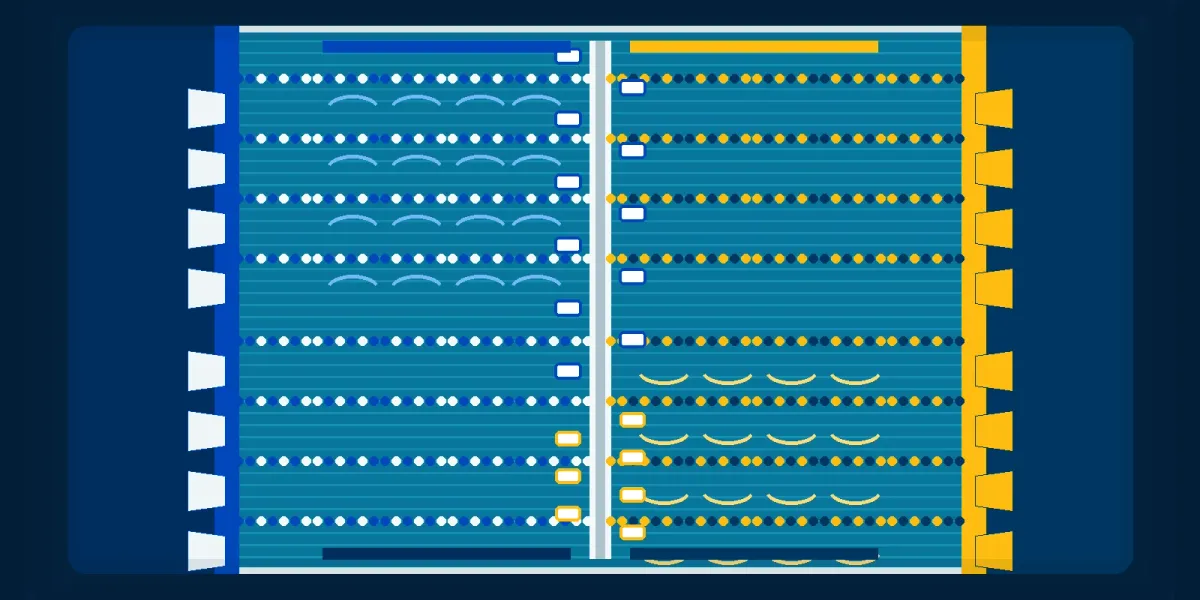
- UC Santa Barbara’s official color guide for the navy
#003660and gold#FEBC11palette used in the original matchup art. - BYU Sport Nuts: MPSF Open Water watch guide, Intermountain Shootout recap, men’s swimming hub and women’s swimming hub.